
Signals of the Week(s): May 8, 2026

Friends, loved ones, comrades. Welcome to your second installment of "Signals of the Week(s)."
A quick refresher: signal scanning, in strategic foresight terms, refers to a systematic process of identifying, tracking, and analyzing early indicators of change (often referred to as "signals") to anticipate future trends or societal shifts. In the words of Marina Gorbis, Executive Director of the Institute for the Future, "A signal is a specific example of the future in the present."
As part of my work leading the Judeofuturism Project, I spend time scanning for signals that might cue various plausible, alternative futures to help me examine and anticipate major trends, shifts and possibilities for American Judaism. This scanning practice––alongside my ongoing research into various frameworks (liturgical, theological, sociological, artistic, embodied)––helps inform my evolving understanding of Judeofuturism. Every few weeks, I informally share some of the more powerful and anomalous signals I encounter, with some questions they have provoked for me in the hopes that they will invite the same in you.
Christian communities launching their own digital infrastructures.
This week, a new US-wide cell phone network was launched as a "Jesus-centric, void of pornography, void of LGBT, void of trans" alternative for Christian mobile users. Radiant Mobile uses cybersecurity technology to block wide swaths of websites. In some ways, this reminds me of the "kosher phones" used by more observant Jewish communities––devices with limited internet access approved by rabbinic authorities and designed to keep out certain content. But where kosher phones seem to be largely a bottom-up community intiative and norm, Radiant Mobile is a venture-backed product with a church revenue-share model and ambitions to expand internationally.
What happens when faith-based digital separation is no longer a niche accommodation, but an innovative product category? As faith communities retreat into curated digital environments, what happens to the shared information commons that pluralism depends on?
When the latest round of fallout and reckoning from the Wexner-Epstein relationship shook the Jewish community earlier this year, Rabbi Joshua Lesser published this beautiful essay, which offers a futurist lens through which Jewish communities can reimagine and redesign the very infrastructure that made this type of rupture and exploitation possible. Among many other ideas, Lesser suggests the establishment of survivor-informed restitution and prevention funds as permanent ethical infrastructure within Jewish communities. A group of Wexner fellows is attempting to do just that with the recently launched ASHRU Fund––named both for the Hebrew phrase commanding us to "aid the wronged" and an acronym of "Advocacy for Survivors, for Healing, Repair and Understanding." The fund aims to raise $100,000 to donate to World Without Exploitation, a coalition focused on ending sexual trafficking, and the National Survivor Network. I see this as an early signal of what it looks like when a Jewish leadership community stops waiting for institutions to act and starts building the infrastructure itself.
How can the ASHRU Fund be a model and crucial first step in repair and redesign? What becomes possible when those closest to harm are the ones designing infrastructure of accountability? What if the next generation of Jewish communal leaders is formed not by prestigious fellowships funded by major donors, but by networks of practice built around shared values?
An evolving conversation on circumcision.
I was walking to my yoga class last weekend when I encountered Harvard Square full of activists carrying signs and megaphones, dressed all in white with, erm, intentionally placed splotches of red paint. After a bit of research, I found out that they were part of a Northeast protest tour by intactivist group, Bloodstained Men. Later that day, I encountered this article, published in The Cut only a few days prior (the irony of the site title is not lost on me). The conversation about circumcision in Jewish communities is a complicated and active one that carries a lot of theological, cultural, and familial weight. But when intactivist groups march through popular college towns and mainstream publications run long features on foreskin restoration, we need to examine this in the context of a much larger political conversation about bodily sovereignty, parental rights, and the limits of religious authority. Last fall, futures nonprofit Democracy 2076 released research predicting 17 new axes of political realignment over the next 30-50 years that do not fall under typical left/right binaries.* One of these axes is beliefs about governance of personal health:
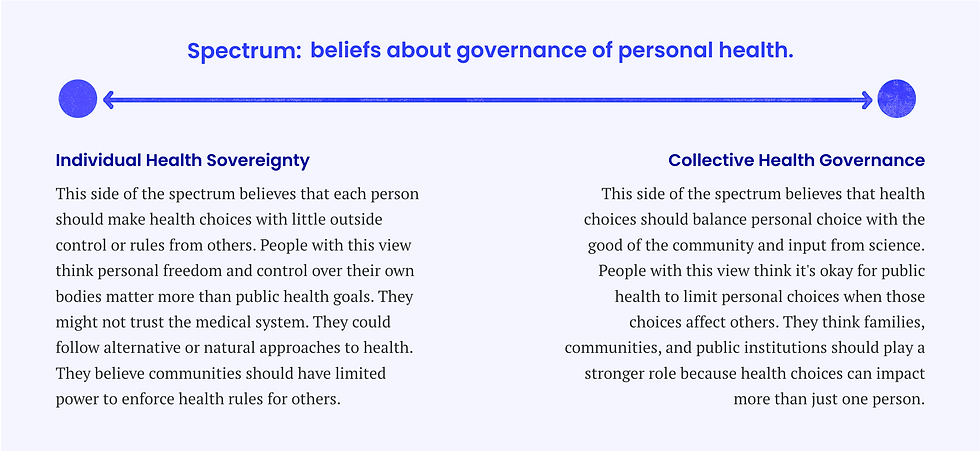
Screenshot from Democracy 2076's report, Pro-Democracy Political Coalitions for 2076 We are in a moment where body autonomy is already under attack––and faith groups on the left and the right are using levers of religious freedom to ensure or eliminate that autonomy. A growing national conversation around circumcision could put Jewish communities in an interesting position at the intersection of consent, progressive frameworks on body sovereignty, parental rights, and religious authority.
Will intactivist visibility create new permission for dissent within Jewish communities, or will it make internal critique of circumcision feel like betrayal? How can political realignments around questions of health autonomy shape existing alliances in/between faith communities and create new ones (eg. Judeo-Christian vs. Jewish/Muslim coalitions)? * I served as a consultant and advisor to Democracy 2076 during this time––including supporting this research.
Upcoming Workshops and Classes
May 11th at 8pm at Lehrhaus Tavern and House of Learning: On Monday, I'll be teaching a class alongside my friend and colleague, Ami Fields-Meyer. Ami is a writer, policy advisor, and political strategist who thinks deeply about Jewish power and courage in the face of authoritarianism. We're going to talk about the importance of history, memory, and storytelling as tools of imagination and future-building for Jewish communal life and American democracy. Join us if you're in Boston!
May 21st at 8pm at Camberville Tikkun Leyl Shavuot 5786/2026: To celebrate the holiday of Shavuot, many Jews stay up all night engaged in Jew-ish learning and unlearning. If you're joining the Camberville Jewish community for Shavuot this year, I'll be teaching around 8pm about Jewish time, imagination, and futurism.
It's officially the time of year that I fall in love with Cambridge again. Amidst the never-ending horrors of the world––the violence around every corner, the ominous rollback of voting rights––it still somehow feels like the universe is stretching her arms in the sunshine and sighing in satisfaction. And the reality of that is as jarring as it is magical. See the photo up top for the gorgeous cherry blossom tree in my courtyard in full, glorious bloom. Here's to trying, imperfectly, to hold it all.
L'shalom,
Becca

Comments