
Signals of the Week(s): April 13, 2026
Updated: Apr 16

Signal scanning, in strategic foresight terms, refers to a systematic process of identifying, tracking, and analyzing early indicators of change (often referred to as "signals") to anticipate future trends or societal shifts. In the words of Marina Gorbis, Executive Director of the Institute for the Future, "A signal is a specific example of the future in the present."
As part of my work leading The Judeofuturism Project, I spend time scanning for signals that might cue various plausible, alternative futures to help me examine and anticipate major trends, shifts and possibilities for American Judaism. This scanning practice––alongside my ongoing research into various frameworks (liturgical, theological, sociological, artistic, embodied)––helps inform my evolving understanding of Judeofuturism. Every few weeks, I informally share some of the more powerful and anomalous signals I encounter, with some questions they have provoked for me in the hopes that they will invite the same in you.
New investment and attention paid to the growth of rural Jewish communities.
For decades, American Jewish organizational life has been centered on a handful of coastal metros. That map is being redrawn. If, like me, you have been closely following "Holy Ground," Benjamin Cohen's ongoing series at The Forward that depicts vibrant, often overlooked, foci of Jewish life outside of major US coastal cities, you likely saw this latest feature on young Jews from major cities across North America being drawn to Tulsa, OK. Just last week, AP published this article on the Center for Small Town Jewish Life's efforts to support Jewish congregations away from large cities. This deliberate redistribution of Jewish communal investment––human and financial––towards smaller cities and rural areas might signal a rethinking of where American Jewish life can and should flourish.
As climate change, economic conditions, and other social and political factors reshape American Jewish geography, what skills and resources will need to be prioritized? What if Jewish institutions designed for density had to fundamentally reinvent themselves for dispersed geographies? How could this unlock new forms of Jewish community-building?
New efforts and experiments to blur the lines between Jewish Education and Jewish Studies.
Jewish education (synagogue schools, day schools, experiential programs) and Jewish studies (the academic discipline, often rooted in universities) have long operated in seemingly parallel universes: one more concerned with identity formation, the other with scholarly rigor. While many of us in either (or both) spaces would argue the boundaries between the two have always been blurred, new experiments are beginning to do so deliberately. Judaism Unbound's UnYeshiva course launching this week brings together Lex Rofeberg, a Jewish educator and rabbi, with Lila Corwin Berman, a professor of Jewish-American history to explore the practical and intellectual implications of Jewish citizenship. This disciplinary crossover raises both exciting possibilities and real tensions about authority and purpose in Jewish learning. I have enthusiastically signed up to attend and will be reporting back!
What new opportunities can we unlock when Jewish studies speaks to Jewish education––and vice versa? Could this class create a model for richer Jewish learning, for Jews and non Jews alike?
Major Jewish nonprofit supporting interfaith families struggles with funding.
Look, I'm not some anonymous futurist bot on the Internet. As a Jew in a loving, multifaith relationship, this one hurt. 18Doors, a national nonprofit supporting interfaith families, significantly reduced its staff amidst funding shortages. This article in The Forward outlines some of the context and potential causes, as well as highlighting how this data point runs counter to many others on interfaith inclusivity in the American Jewish community.
Is this a signal of an organization not serving the community's needs, or the Jewish philanthropic ecosystem being less responsive to a changing (arguably, already changed) community? What if smaller, hyper-local organizations turn out to be better suited to serve interfaith families than a large national institution?
Not a Signal, but Noteworthy
I was wandering the streets of NYC last week and stumbled upon this "free to the public" exhibit at MoMA: The Many Lives of the Nakagin Capsule Tower. Completed in 1972 by Japanese architect Kisho Kurokawa, the Nakagin Capsule Tower was the defining achievement of Metabolism, an avant-garde movement that imagined cities as living, evolving organisms. In this case, it envisioned the capsules of the tower being shed and reimagined as part of a dynamic system that adapted to the shifting needs of its inhabitants and the city around it. The capsules took on lives of their own over the decades––transformed from micro-dwellings for commuting businessmen into art studios, tea rooms, libraries, and DJ booths––before the building was controversially demolished in 2022. It's a bittersweet tribute to a visionary structure and a beautiful story of how architecture outlives its original intentions.

I'm also sharing pictures of Kurokawa's "Capsule Declaration" here, in which he writes how the capsule itself is a future-oriented response to trends in urban life and family systems: "People will gradually lose their desire for property such as land and big houses and will begin to value having the opportunity and the means for free movement." The Declaration is also a beautiful rendering of Kurokawa's own vision for the future he wanted: "a society where maximum freedom for individuals is sanctioned and where there is a wide range of options."

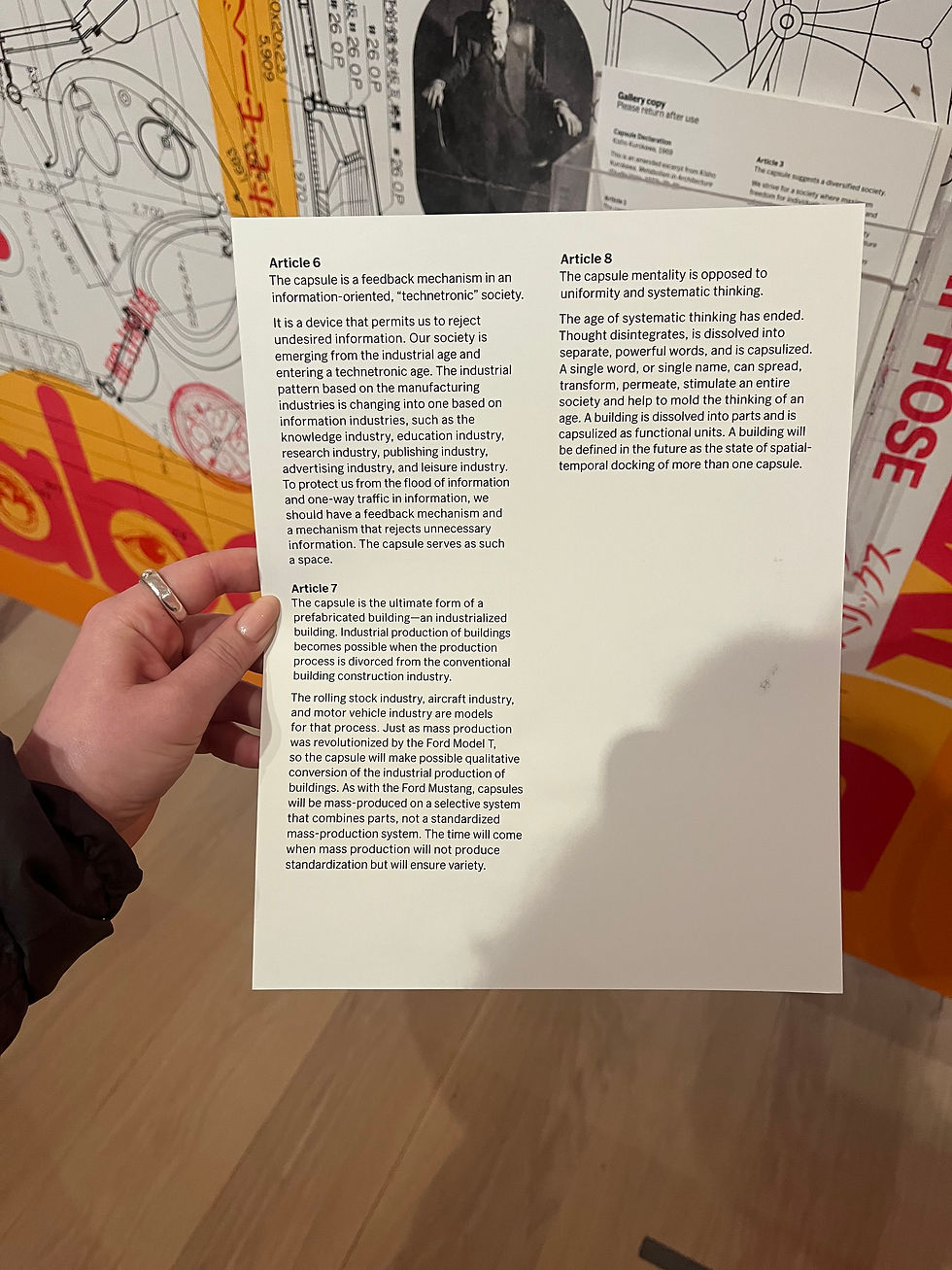
I once wrote a paper about our preoccupation with buildings in Jewish communities––how institutions often cling to physical edifices as a symbol of wealth and security, despite the needs of its community changing around it. The Nakagin Tower offers a different imagination entirely: a building conceived as a living organism, its capsules meant to be shed and renewed. Most weren't. But the ones that survived until the building's end were transformed by their inhabitants into something unrecognizable from the original vision, and somehow more alive for it.
Perhaps that's not a bad metaphor for where we are.
Send me what you're finding out there. See you here soon.
L'shalom,
Becca


Comments